
"Sustainability is essential for the continuity of your business"
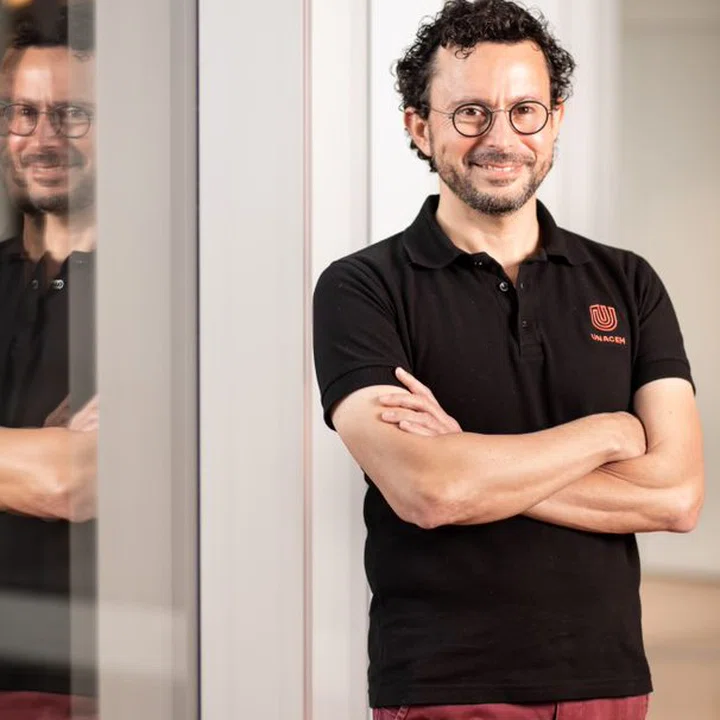
Photo: The CEO of UNACEM Group, Pedro Lerner. Credits: Karen Zárate, G magazine.
By Álvaro Ballesteros
COVID-19 was a turning point for companies worldwide. The impact of the pandemic forced companies to rethink their purpose and, above all, their footprint on society and the environment. As a result of this learning, in 2021, Grupo UNACEM, a holding company that integrates companies in the cement, concrete, and energy sectors, declared its aspiration to become a "carbon neutral" company by 2050.
Pedro Lerner, a graduate of the Massachusetts Institute of Technology in technology and strategy, as well as in electrical engineering and computer science, leads the group in the profound process of change initiated where sustainability marks the actions promoted to build a more innovative future for society, business, and the environment, as reflected in the company's code of ethics and conduct.
Currently, technology and research are key drivers of business development. How has Grupo UNACEM adapted to this new reality? What changes has this transformation driven within the group?
At Grupo UNACEM, we are transforming our processes and our way of working to seek innovative solutions across all our companies. In some operations, we have approached the market using tools such as WhatsApp Business, chatbots, and business analytics to better understand market realities and define strategies. In other cases, we have brought this wave of innovation to administrative processes. We aspire to become a data-driven group that uses advanced analytics to improve our performance and efficiency.
As an example of adaptation and innovation, we can mention the digitalization of a large percentage of the operations of our two hydroelectric power plants, El Platanal (Cañete, Lima) and Marañón (Huamalies, Huánuco), to manage them remotely from a control center located in Lima. This reduces our energy consumption, waste generation, and fuel use for transport, and therefore, our CO2 emissions. In August of this year, we will incorporate into this remote management the three hydroelectric plants that generate energy for the cement plants of Condorcocha (Tarma) and Atocongo (Lima).
What strategy and objectives does Grupo UNACEM have in place to promote innovation across its different companies?
Innovation is a strategic pillar of Grupo UNACEM. Therefore, we have started conducting workshops at the managerial level on concepts associated with digital transformation and innovation. The objective is for all members to understand and practice these concepts to develop our own digital transformation and innovation roadmap. At the same time, we have started training in agile methodologies to incorporate them into project management, as these focus on people and allow for the integration of teamwork, innovation, and creativity into the organization's culture.
As an example of these actions, in Ecuador, we carried out the Sikana project, with which we seek to raise awareness among our employees about two strategic lines: innovation and sustainability.
Promoting this innovative culture opens up various challenges and opportunities, especially for a group that integrates companies with different market approaches, as is the case with UNACEM. How does the company face this challenge?
In 2020 and 2021, the group made important decisions to initiate a profound transformation. We organized ourselves to promote collaboration and enable synergies between related businesses to become a corporate holding with a recognizable identity, respecting the successes achieved by our predecessors, without whom none of what we are doing today would be possible.
Currently, the level of adherence achieved by management and leadership members is very high. Change and modernization are well received because they generate excitement and create opportunities. As an example, we can take the possibilities that have opened up for individual development and career plans. Similarly, we have also undertaken process standardization to improve automation and generate efficiencies.
We do not fail to acknowledge that every transformation brings with it some losses that must be addressed or managed, but we do not lose sight of the fact that organizations owe their success or failure to the people who comprise them.
How is Grupo UNACEM implementing an innovative culture in companies with different value propositions, such as Celepsa? What synergies are produced between the different companies in the group by belonging to the same innovative culture? Could you give an example?
With the purpose of accelerating the decarbonization of Peru, and under an environmentally respectful vision, Celepsa aligns with Grupo UNACEM's objective through the Triple C (Celepsa Carbon Negative Commitment) label, which promotes a business movement to advance towards carbon neutrality. To date, we have certified four companies, including UNACEM Peru, thanks to the use of renewable energy in their operations during 2021. Actions like this allow us to unitedly achieve our goal of being a carbon-neutral company by 2050.
Furthermore, Celepsa is creating an innovation laboratory at UNACEM Peru's Condorcocha plant. This laboratory will test renewable generation technologies, photovoltaic, wind, and storage under complex conditions such as an altitude of 3800 meters and a cold climate with precipitation and hail.
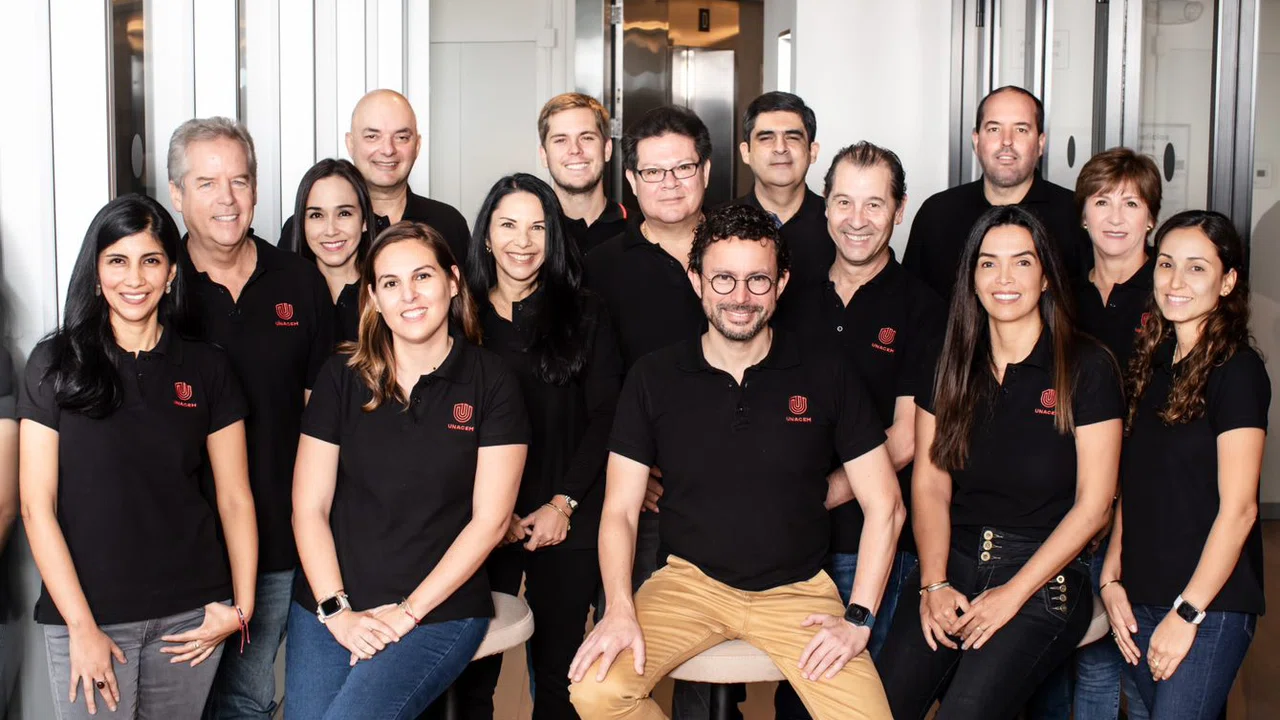
Photo: The CEO of UNACEM Group, Pedro Lerner, with his corporate team. Credits: Karen Zárate, G magazine.
The integration of ESG criteria into company roadmaps has been established as guidelines to promote a sustainable and respectful impact through the companies' actions. What measures are underway at UNACEM Group to integrate these factors?
At Grupo UNACEM, our corporate board has five committees, one of which is specifically dedicated to strategy and sustainability. Its mission is to ensure that the strategic initiatives of the holding companies incorporate ESG criteria to guarantee the sustainability of our businesses, their profitable growth, and the generation of value for all our stakeholders.
Committing to sustainability is essential for business continuity. It creates value for employees, society, shareholders, and customers. It is a source of wealth generation that creates a virtuous circle that also positively impacts reputation. Moreover, it allows you to attract talent to, later, create a company with a more competitive future.
Therefore, in 2021, we renewed our purpose of “Together we grow to build a sustainable world” and presented a first sustainability statement to our Shareholders' Meeting. Based on this, this year, we approved a new Corporate Strategic Plan that will serve as a guide for all companies in the UNACEM Group.
How have you incorporated innovation into your production processes with the aim of reducing environmental impact?
Currently, UNACEM Group companies have management lines aimed at preventing and reducing our environmental footprint. Our challenge is to achieve carbon neutrality before 2050, and to this end, for years we have been promoting initiatives that contribute to mitigating and adapting to the effects of climate change.
Regarding our products, we are increasingly producing high-strength, low-carbon footprint cements. For example, in UNACEM Ecuador, we use 40% natural pozzolan of volcanic origin; we replace virgin natural resources with recycled or synthetic materials such as synthetic gypsum or ceramic industry waste instead of natural gypsum; and we use alternative fuels. In our Atocongo plant, we use natural gas, which has allowed us to reduce greenhouse gas emissions from fuel consumption by more than 25%.
Regarding the circular economy strategy of our production process, and under strict quality control, in some concrete plants we reuse water and aggregates to minimize waste management.
In recent years, the need to build healthier and more sustainable cities has been highlighted. How does Grupo UNACEM contribute to this purpose? Could you highlight an example of social innovation?
UNACEM Group companies have implemented projects based on social innovation, technology, and aligned with the United Nations Sustainable Development Goals (SDGs).
For example, in Peru, we promote the development of our communities neighboring our cement operation, through the donation of cement, paving stones, and concrete, as well as the execution of works with community participation. All of this positively impacts SDG 11 (Sustainable Cities and Communities), as it allows hundreds of families to access adequate and affordable housing and basic services.
In addition, we promote better lifestyles, nutrition, and healthy environments in neighboring communities, strengthening the capacities of individuals, families, leaders, and community health agents for self-care. This is possible through a virtual training platform managed by the UNACEM Association, significantly aligned with SDG 3 (Good Health and Well-being).
In recent years, the need to build healthier and more sustainable cities has been highlighted. How does Grupo UNACEM contribute to this purpose? Could you highlight an example?
All our operations seek to be increasingly eco-efficient, modern, and safe, and to contribute to people's quality of life, as well as to the mitigation of and adaptation to the effects of climate change. To achieve this, we use technology and innovation as allies.
Through UNACEM Peru, we have built an underground conveyor belt over 8 km long to eliminate the impacts generated by material transportation. This belt runs from our Atocongo plant to the port facilities in Conchán.
On the other hand, with Celepsa, we are in the final stage of obtaining permits for the development of what would be Peru's largest photovoltaic park, with a capacity of 250 MW.
What technologies and innovations are helping Grupo UNACEM advance towards a future where sustainability dictates the next steps for businesses?
Becoming a carbon-neutral company by 2050 implies a great technological commitment.
As an example, we are increasingly using latest-generation cements, recycled aggregates, and additives that allow for the development of more sustainable and durable concrete, whose production optimizes the use of raw materials.
Likewise, we continue to make technological innovations to increase the efficiency of our water resource utilization, and we are developing innovation laboratories to experiment with new technologies.
Finally, in some operations, we have started using artificial intelligence to optimize energy, as well as the use of natural resources in the cement grinding process. Similarly, we have begun to apply data science for predicting equipment and process component failures.
In times of uncertainty and instability like those we are currently experiencing, how can innovation and technologies help continue to provide a positive and quality response to suppliers and customers?
An environment of social, political, and economic stability is important for the development of markets and societies. Nevertheless, it is also true that uncertainty and instability can sharpen the focus and creativity needed to innovate and develop tangible solutions and benefits from new technologies.
Editorial horizon
Intelligence
A curated body of Opinno thinking on how leaders read markets, technologies, signals, and emerging opportunities with more clarity and speed.
Related Insights

Voices
"We must stop fearing technology and think about how it brings value to citizens"
By May Ponzo Founded in 1906 as "The Haloid Photographic Company" by Chester Carlson in New York, Xerox initially focused on photographic products. The company'
Voices
“We have the computational power and the data science capabilities to really understand what drives population health”
Photo: Ann Aerts, Head of the Novartis Foundation. Credit: Novartis Foundation. By Elena Astorga Cardiovascular diseases (CVDs) were responsible for 20.5 millio

Voices
“Generative artificial intelligence is going to change what it means to be human”
Photo: Nina Schick, Generative AI expert consultant. Credit: Courtesy of Nina Schick. By Elena Astorga Since OpenAI kicked off the generative AI craze with the
Ready to accelerate your innovation?
Book a strategy call with our experts to explore how we can help you scale your impact.
Book a Strategy Call